
Teaching revision
Academic success (part 3): 3 layers of an effective revision strategy

This is a guest post by Head of Department, Christopher Walker.
Every teacher knows the sinking feeling. It’s March, mock results are in, and you’re looking at a student’s revision materials. The textbook is a rainbow of highlighter. Their notes have been meticulously copied out - twice. They’ve created beautiful flashcards that have never left their bedroom. They’ve spent hours revising, but none of it has stuck.
As experienced teachers and subject specialists, we instinctively know how to learn in our disciplines. We understand which techniques build long-term retention and which create false confidence. But this expertise creates a blind spot. We’ve forgotten what it’s like not to know how to revise effectively.
When we tell students “you need to revise,” we assume they share our metacognitive toolkit. They don’t. To a struggling Year 11 student, “revision” might mean re-reading notes passively, highlighting randomly, or creating elaborate resources that look productive but build little learning. The gap is stark: expert teachers have expert knowledge of learning that students lack entirely.
When school habits and curriculum routines and targeted intervention work together systematically - as explored in our previous articles - they create conditions for steady progress.
But there’s a third crucial element these high-performing schools understand: ensuring students know how to learn independently.
In this third piece (of three) about academic success, I share three distinct layers 29 high performing secondary schools use to help students remember more:
whole school
subject specific applications
breaking down the techniques
If you missed parts 1 and 2:
read: “Academic outcomes success (part 1): habits of high performing schools“.
read: “Academic outcomes success (part 2): curriculum and intervention that works“.

Premium members get more. Much more.
Not a member? Get a trial here
But before we get into the three layers, a quick plug…
📅 National Pupil Premium Conference in partnership with E-ACT

How do you get the best outcomes for our most vulnerable students?
This might be the most important question you can ask yourself as an educator.
Join us for our first National Pupil Premium Conference, delivered in partnership with E-ACT, to learn how some of the highest performing schools achieve exceptional outcomes for their disadvantaged students.
📆 23rd Feb 2026
📍Heartlands Academy E-ACT, Birmingham.
Spaces limited.
The Research Finding: Revision as Curriculum
Across the 29 high-performing schools we analysed, a clear pattern emerged. These schools don’t leave revision to chance or treat it as assumed knowledge. Instead, they approach it with the same systematic rigour they apply to curriculum design.
The principle was articulated clearly in the research: “Schools with the strongest outcomes show students how to plan their revision, practise effectively and review their progress. Revision becomes a skill in itself, rather than something students solve alone at home.”
The scale of provision was striking. 15 of the 29 schools published comprehensive revision materials online. Multiple schools embedded study skills into dedicated curriculum time. Strategic timing meant year-round instruction, not just pre-exam panic.
What distinguished these schools wasn’t just that they taught revision, but how they structured this teaching. Three distinct layers emerged: whole-school frameworks, subject-specific applications, and granular technique instruction.
Layer One: The Whole-School Framework
Several schools go beyond providing revision techniques - they teach students why certain approaches work. This foundation in cognitive science, made accessible to teenagers, transforms revision from mysterious obligation into understandable skill.
One school’s approach exemplifies this approach. Their comprehensive Study Skills Programme addresses the root cause of exam anxiety head-on: “A lot of stress and anxiety around exams can often stem from a feeling of being overwhelmed and not in control. Our overriding message is that knowledge is power; we believe that learning how to study properly and having the tools to do so is empowering for our students and helps revision & exams seem less daunting!”
Their programme includes explicit curriculum time dedicated to metacognition, structured progressive resources from Year 9 onwards, and evidence-informed teaching about retrieval practice, spacing effects, and why re-reading creates false confidence.
This raises an immediate concern for curriculum leaders: aren’t we already struggling to fit everything in? The schools achieving strongest outcomes have reframed this question.
Without these skills, students can’t access the curriculum effectively.
Different schools find different solutions - PSHE time, dedicated tutor programmes across Year 9-10, or focused sessions before mocks.
The approach works because it’s proactive (starting early, not in Year 11 panic), universal (all students, not just those struggling), evidence-based (students understand why techniques work), and transferable (building metacognitive skills beyond GCSEs).
Layer Two: Subject-Specific Application
While whole-school frameworks provide foundation, effective provision recognises that revision looks fundamentally different across subjects. The techniques that build retention in History don’t mirror those needed for Mathematics.
Generic advice like “make flashcards” falls short because it doesn’t help students understand what to put on those flashcards for their specific subject. This is where many students falter.
One school’s online Study Hub demonstrates sophisticated understanding of disciplinary differences. Their centralised hub includes a Key Stage 4 Revision Booklet establishing general principles, then “Subject Specific Revision Information“ drilling down to disciplinary approaches - resources organised progressively from understanding effective study habits through to exam technique.

What does this look like in practice?
For English Literature, guidance addresses how to revise quotations efficiently, organise character development notes, and practice essay planning for different question types.
For Science, materials explain how to transform diagrams into explanations and vice versa, testing true understanding rather than recognition.
For Mathematics, guidance clarifies which topics require procedural practice versus conceptual understanding.
One MAT takes subject-specific support further with strategic timing. Their “Night Before Exam” online revision sessions run 6:00-7:15pm the evening before each exam paper - subject-specialist teachers delivering targeted exam technique and recall strategies, not content teaching.

This level of provision requires departmental ownership (Heads of Department creating guidance), quality assurance (ensuring advice is evidence-informed, not personal preference), and protected time (building into department improvement plans). The key question for curriculum leaders: do your departments have subject-specific guidance, or are students receiving only generic whole-school advice?
Layer Three: Breaking Down Techniques
Even with frameworks and subject-specific applications, students can struggle if they don’t understand the mechanics of individual techniques. The most effective schools don’t just name techniques - they break them down into replicable processes.
Consider flashcards. Most students have heard they should use flashcards. Many have created them. Far fewer use them effectively. Effective guidance provides structure: identify specific knowledge (not just “Chemistry” but “collision theory”), apply design principles (one question per card, concise prompts), use actively (write or say answers, never just “in your head”), and respond to feedback (retire secure cards, create new ones for gaps).

Why does this detail matter?
Research shows students often use techniques ineffectively - creating beautiful flashcards but never testing themselves, answering “in their head” (creating false confidence), or not spacing retrieval practice.
The same principle applies to brain dumps (timed writing with no prompts, categorising information, identifying gaps), self-quizzing protocols (review, cover, answer without notes, self-mark, identify gaps), and mind mapping for synthesis (main topic centred, strategic use of colour, avoiding overcrowding).
Each technique breakdown follows the same structure: what it is, why it works, how to do it step-by-step, common pitfalls to avoid, and how to know if it’s working. This removes ambiguity - students aren’t left wondering if they’re “doing it right.”
For curriculum leaders, this granular guidance can be created centrally and adapted by departments with subject-specific examples, taught explicitly in tutor time or revision lessons, and provided to parents to bridge the home-school gap.
Sent this by a friend?
Making It Accessible: The Infrastructure
Creating high-quality guidance is necessary but insufficient. The best resources have no impact if students can’t find them when needed.
The most effective schools created centralised revision hubs - one-stop shops for all resources. One MAT’s Year 11 Revision Padlet organises resources by subject, with each section containing links to online resources, past papers, school-created guidance, and video content.

Centralisation provides clear advantages: students don’t need to remember where resources are stored, parents can see what’s available, teachers share consistent messaging, and resources can be updated centrally while tracking which are accessed most.
Several schools recognised that effective home support requires parental understanding. Strong parent communications explain what works and what doesn’t in accessible language, provide specific practical suggestions beyond “encourage them to revise,” offer curated recommendations for apps and websites, and clarify when to be concerned versus normal exam stress.
Schools also provided practical tools: revision timetable templates with realistic time blocks and built-in breaks, and subject-specific checklists allowing students to self-assess confidence by topic and track completion.
What This Means for Curriculum Leaders
The schools achieving the strongest outcomes have built systematic approaches at multiple levels. For curriculum leaders, the question becomes: how do we audit current provision and develop it strategically?
The audit questions:
Whole-school: Is there dedicated curriculum time for metacognition? Are students taught why techniques work? Is there consistent, evidence-informed messaging?
Departmental: Does each department have subject-specific guidance? Are techniques taught before exam season? Do schemes of learning include retrieval practice opportunities?
Resource: Can students access step-by-step guides? Is there a centralised hub? Are materials accessible to parents?
Infrastructure: Do students know what exists and where to find it? Is there clear ownership for maintaining resources?
Starting points (pragmatic and manageable):
If starting from scratch: Create one high-quality guide for one technique usable across subjects. Dedicate one assembly/tutor time per half-term to teaching revision skills. Ask one department to pilot subject-specific guidance.
If you have some provision: Audit what exists (you may have more than you realise, just not coordinated). Make it accessible by creating one centralised location. Ensure consistency by reviewing departmental advice for contradictions.
If enhancing existing provision: Add the “why” (cognitive science explanations). Increase subject-specificity (translate generic advice into disciplinary practice). Consider strategic timing (night-before sessions or progressive curriculum embedding). Develop parent partnership materials.
The resource consideration:
This work requires time, but it’s an investment that compounds. Once created, resources serve every subsequent cohort. Consider phasing over 2-3 years, using existing expertise in your school, sharing between departments, and partnering with other schools to divide development work.
The impact:
When revision is taught systematically, students feel more in control (reducing anxiety), revision becomes more efficient (focusing on high-impact techniques), independent learning skills develop (transferable beyond GCSEs), and achievement gaps narrow (all students access effective techniques, not just those with home support).
Access the Full Research
If you’re investigating or evaluating your own school’s year 11 and/or whole school academic success strategy, paying members can read part II of this article, which allows you to see which schools employ which strategies and resources so you can investigate further and contact them.
Paying members have the ability to:
find schools like yours in a filterable and sortable directory of schools and strategies
access a bank of 240 academic success resources (curriculum maps, intervention plans, student and parent handbooks, letters and more_
Not a member? Get a trial here
Access the full analysis and download revision, intervention and academic success resources from a single database
To help you find schools like yours, we’ve created a sortable and filterable directory* of academic success practice.
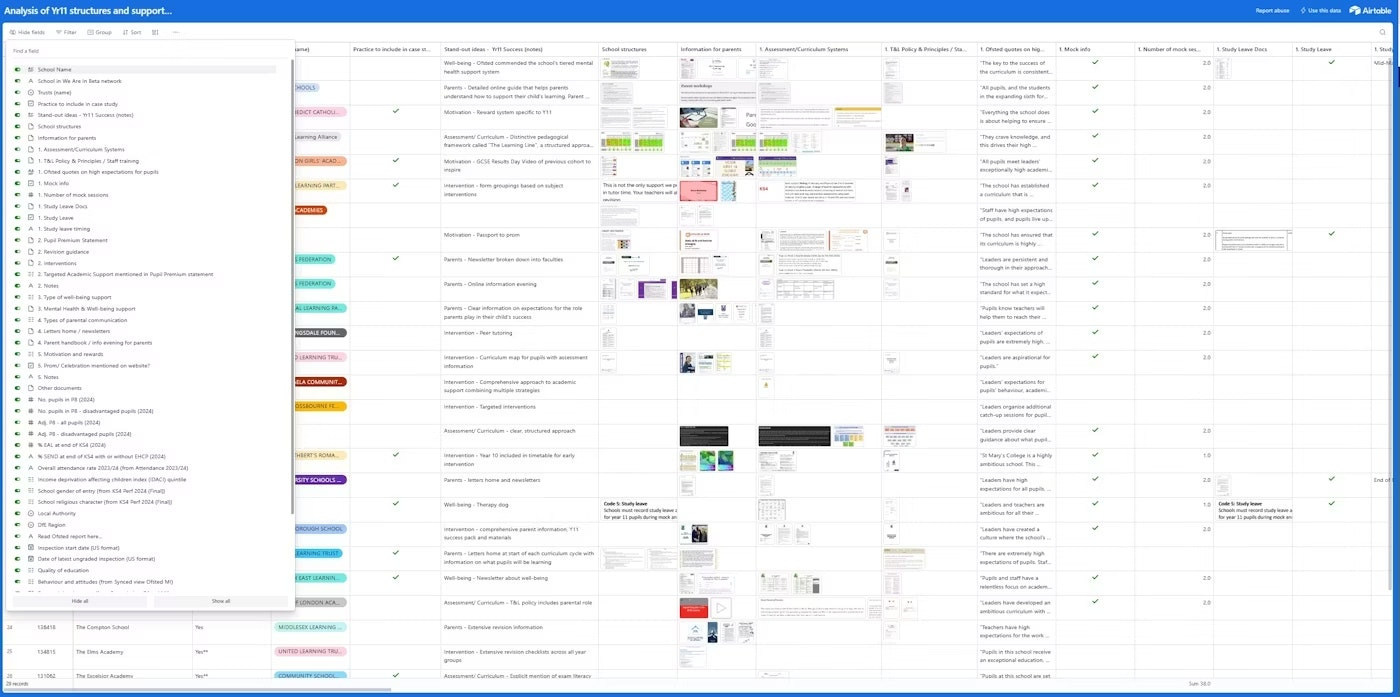
*Access
Lite version here: academic success strategies without resources or schools directory
Premium version here: academic outcomes strategies, resources and named schools.
Resources and recordings are only available to paying members of the Curriculum Thinkers Community who can:
learn from hundreds of recordings covering every aspect of curriculum development across 20 subjects
download 2000+ resources - both whole school and subject specific
access 700+ academic related policies, plus analysis of them, from successful schools - T&L, assessment, homework and more.
save hundreds via our partner discounts
promote your vacancies in our newsletters that go out 23,000 school leaders and teachers
Not a member? Get a trial here
Already a member but can’t access, DM Fiona Flint and ask her for your membership activation link.
Access a bank of academic success resources
Curriculum, intervention calendars, student, parent handbooks, letters and more

💼 Jobs with members of the We Are In Beta Community.
If you want to get your vacancies seen by the 23k school leaders and teachers who receive We Are In Beta newsletters across curriculum, pastoral and more, let us know here and we’ll send more info.
System / MAT Leadership
Assistant Strategic Leader for Inclusion - (Prince Albert Community Trust, Birmingham) - Apply here.
Lead Practitioner Mathematics - North East - (Oasis Community Learning, Lincolnshire) - Apply here.
Lead Practitioner of English - North East - (Oasis Community Learning, Lincolnshire) - Apply here.
Chief Financial Officer (CFO) - (King’s Group Academies, Portsmouth) - Apply here.
Head of Financial Reporting - (United Learning Trust, Peterborough) - Apply here.
Trust Procurement Leader - (Prince Albert Community Trust, Birmingham) - Apply here.
People Partner (Berkshire Cluster) - (King’s Group Academies, West Berkshire) - Apply here.
Trust Director (Governor) - (Fairfax Multi Academy Trust, Birmingham/Solihull) - Apply here.
Trust Member (Governor) - (Fairfax Multi Academy Trust, Birmingham/Solihull) - Apply here.
Senior Leadership
Assistant Principal - SEND & EAL - Fulwood Academy (Dunstone Education Trust, Lancashire) Apply here.
Assistant Headteacher SENDCo - Harris Church of England Academy (Diocese of Coventry Multi Academy Trust, Warwickshire) Apply here.
Intervention Lead - Hartland High School (Greenshaw Learning Trust, Reading) Apply here.
Head of Specialist Resource Provision – Vision Impairment - Woking High School (Woking High School Academy Trust , Surrey) Apply here.
Middle Leadership
Head of Spanish - Oxted School (Howard Partnership Trust, Surrey) Apply here.
Head of Modern Foreign Languages - Oxted School (Howard Partnership Trust, Surrey) Apply here.
Head of Science - Maternity Cover - Yate Academy (Greenshaw Learning Trust, South Gloucestershire) Apply here.
Second in Charge (2iC) - Westminster Academy (Westminster Academy Trust, Westminster) Apply here.
Head of Maths - Brighton Aldridge Community Academy (Aldridge Education, Brighton and Hove) Apply here.
Head of Humanities - Alvaston Moor Academy (Archway Learning Trust, Derby) Apply here.
Lead Professional (Head of Department) Business - Q3 Academy Langley (The Mercian Trust, Sandwell) Apply here.
Director of Sport - Cleeve School (Gloucestershire) Apply here.
Head of PE - Alvaston Moor Academy (Archway Learning Trust, Derby) Apply here
Head of Classics - Harris Academy Chafford Hundred (Harris Federation, Thurrock) Apply here.
Faculty Lead for Creative Arts - Hadleigh High School (Penrose Learning Trust, Suffolk) Apply here.
Head of Year - St Gregory’s Catholic School (Kent Catholic Schools’ Partnership, Kent) Apply here.
Head of Year - Gloucester Academy (Greenshaw Learning Trust, Gloucestershire) Apply here.
Assistant Head of Year - Stoke Damerel Community College (Greenshaw Learning Trust, Plymouth) Apply here.
Assistant Head of Year - Challney High School for Girls (Chiltern Learning Trust, Bedfordshire) Apply here.
Teaching
Classroom Teacher (main pay range) - Nishkam School West London (Nishkam Schools Multi-Academy Trust , Hounslow) Apply here.
Maths
Teacher of Maths - Les Quennevais School (Les Quennevais School, Jersey) Apply here.
Teacher of Maths - Fulwood Academy (Dunstone Education Trust, Lancashire) Apply here.
Maths Teacher - Thurstable School (Essex) Apply here.
Teacher of Maths - Westminster Academy (Westminster Academy Trust, Westminster) Apply here.
English
Teacher of English - Claydon High School (Penrose Learning Trust, Suffolk) Apply here.
Teacher of English - East Bergholt High School (Penrose Learning Trust, Suffolk) Apply here.
Teacher of English - Nishkam School West London (Nishkam Schools Multi-Academy Trust , Hounslow) Apply here.
Teacher of English - Fulwood Academy (Dunstone Education Trust, Lancashire) Apply here.
Teacher of English - Q3 Academy Langley (The Mercian Trust, Sandwell) Apply here.
English Teacher (Mat Cover) - Coombe Wood School (Greenshaw Learning Trust, Croydon) Apply here.
Science
Teacher of Science - Westminster Academy (Westminster Academy Trust, Westminster) Apply here.
Teacher of Science - Alvaston Moor Academy (Archway Learning Trust, Derby) Apply here.
Teacher of Science (Biology) Maternity Cover - The Long Eaton School (Archway Learning Trust, Derbyshire) Apply here.
Teacher of Science - Fulwood Academy (Dunstone Education Trust, Lancashire) Apply here.
Teacher of Science (covering maternity leave) - King’s Academy Easthampstead Park (King’s Group Academies, Bracknell Forest) Apply here.
Teacher of Science - Saint Benedict Catholic Voluntary Academy (St Ralph Sherwin Catholic Multi Academy Trust, Derby) Apply here.
Teacher of Science - Oxted School (Howard Partnership Trust, Surrey) Apply here.
Teacher of Science - Maternity Cover - Yate Academy (Greenshaw Learning Trust, South Gloucestershire) Apply here.
PE
Teacher of Girls’ PE - Holmleigh Park High School (Greenshaw Learning Trust, Gloucestershire) Apply here.
Teacher of PE (Female) - St Gregory’s Catholic School (Kent Catholic Schools’ Partnership, Kent) Apply here.
Design & Technology
Teacher of Design & Technology - Alvaston Moor Academy (Archway Learning Trust, Derby) Apply here.
Teacher of Design & Technology - with the ability to teach Child Development or Engineering Design - Challney High School for Girls (Chiltern Learning Trust, Bedfordshire) Apply here.
Business and Computing
Teacher of Business and Computer Science - Alvaston Moor Academy (Archway Learning Trust, Derby) Apply here.
Teacher of Business Studies - Oxted School (Howard Partnership Trust, Surrey) Apply here.
Citizenship and Politics
Teacher of Citizenship & Politics - Carshalton High School for Girls (Girls Learning Trust, Sutton) Apply here.
Languages
Teacher of Spanish - Oxted School (Howard Partnership Trust, Surrey) Apply here.
Drama & Oracy
Part time Teacher of Drama 0.8 Maternity Cover - St John Fisher Catholic Comprehensive School (Voluntary aided school, Medway) Apply here.
Drama & Oracy Teacher - Broadwater School (Greenshaw Learning Trust, Surrey) Apply here.
Operations and support roles
If you are looking for operations and (pastoral and learning) support roles, there are 40+ of them in here 👇

Sent with ❤️ from the Curriculum Thinkers Team at We Are In Beta.